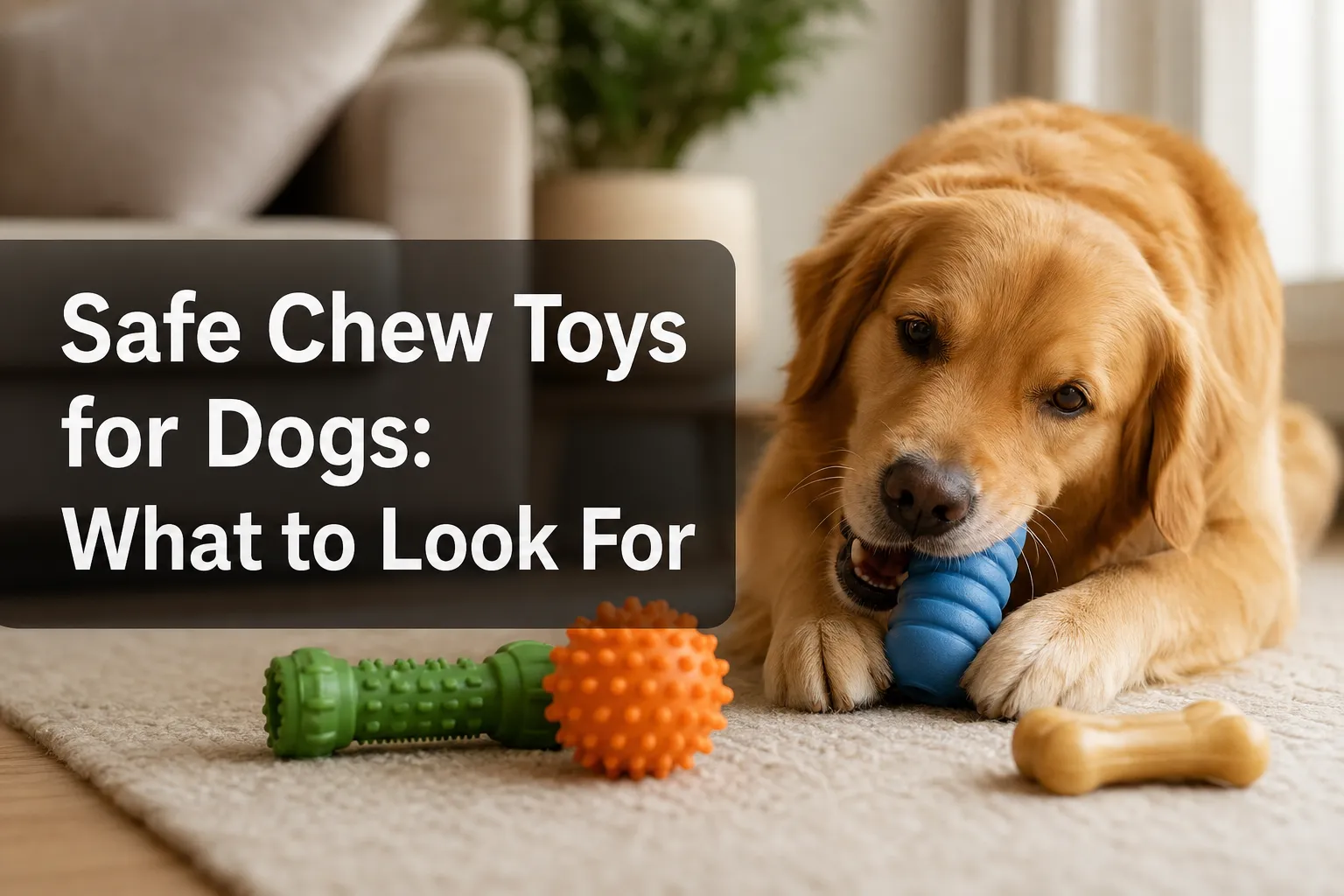
Safe Chew Toys for Dogs: What to Look For
Choosing safe chew toys for dogs can feel harder than it should. One package says “durable,” another says “for aggressive chewers,” and plenty of toys look sturdy until they splinter, fray, or become a choking risk. If you want to buy confidently – not just hopefully – this guide will help you judge a chew toy before it ever reaches your dog’s mouth.
For busy pet parents, the goal is simple: find a toy that matches your dog’s chewing style, supports everyday enrichment, and does not create avoidable dental or swallowing hazards. That means looking beyond marketing claims and focusing on material, size, flexibility, durability, and how your individual dog actually plays.
At Pawzis, we believe everyday pet care should feel simpler. A curated store, practical essentials, and clear guidance matter when you’re trying to choose the best chew toys for dogs without getting lost in an endless catalog.
What the Top-Ranking Advice Gets Right – and What It Often Misses
Most high-performing articles agree on a few smart basics:
Harder is not always better
Size matters
Dogs have different chew styles
Worn toys should be replaced
Supervision still matters, even with durable toys
That advice is helpful, but many articles stop there. The biggest content gaps are usually:
How to assess a toy before buying it
How to match toy structure to a specific chewing pattern
How to spot early signs that a toy is becoming unsafe
How puppy, adult, and heavy-chewer needs differ
How to avoid dental damage, not just choking hazards
This guide fills those gaps so you can evaluate recommended chew toys for dogs more like a careful buyer and less like you’re guessing from reviews.
The Fastest Safety Check: 7 Things to Look For Before You Buy
If you only remember one section, make it this one. A chew toy is more likely to be safe when it checks most of these boxes.
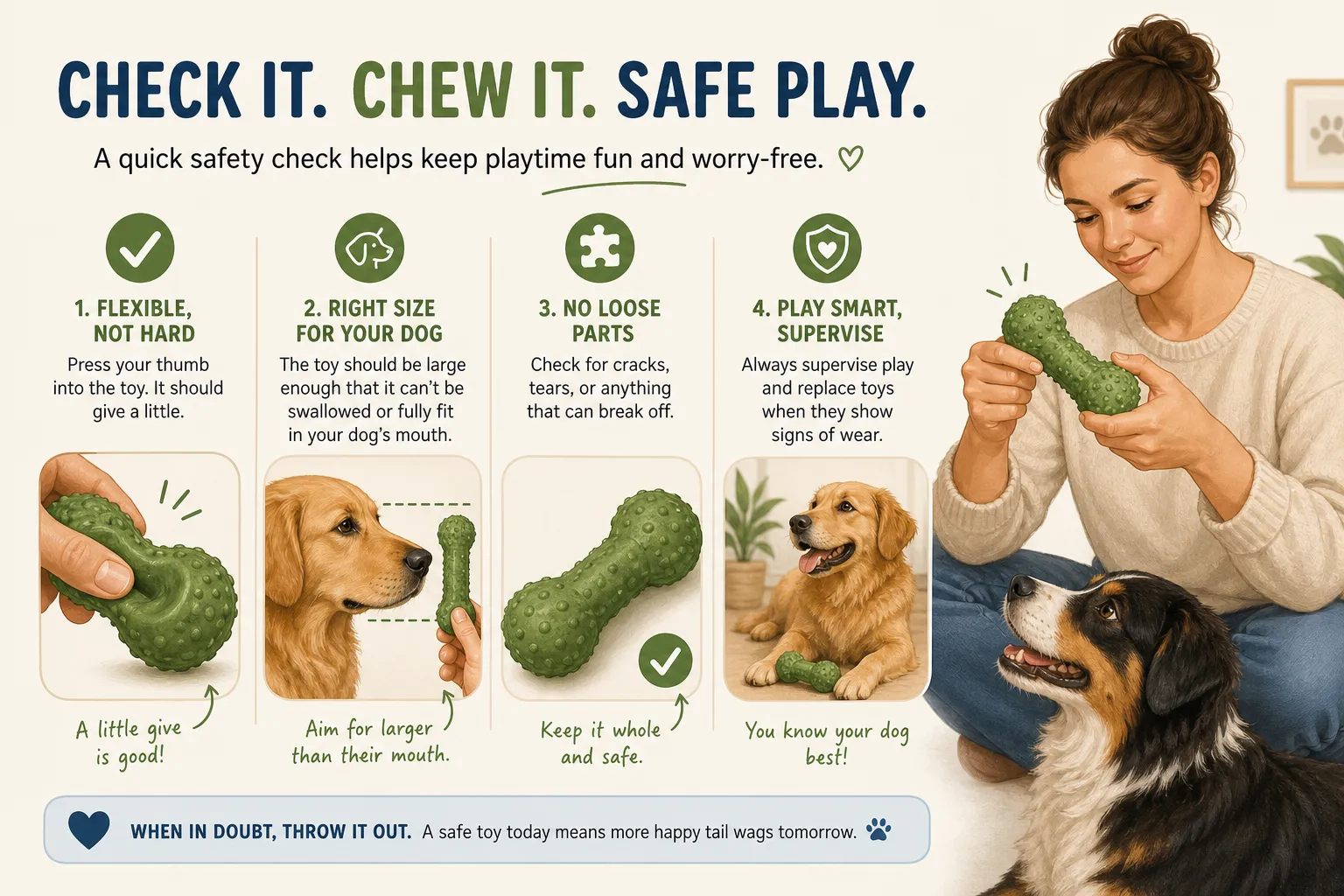
1. It Has Some Give
A toy should not feel rock-hard. Many veterinary dental sources caution against overly hard chews because dogs can crack teeth on them. As a practical rule, if you cannot press into it with your thumbnail or it feels as hard as bone, skip it.
2. It Matches Your Dog’s Mouth Size
A toy should be large enough that your dog cannot fit the whole thing into the back of the mouth. Too-small toys create swallowing and choking risks. Too-large toys may be awkward and frustrating, especially for puppies or small breeds.
3. It Has No Loose or Breakable Parts
Avoid toys with glued-on eyes, squeakers that can easily come free, brittle edges, beads, straps, or decorative attachments. The safest chew toys for dogs are structurally simple.
4. It Uses Safer Materials
Look for non-toxic, dog-appropriate materials such as natural rubber or flexible, pet-safe silicone in toys meant for chewing. Not every dog-safe toy needs to be ultra-soft, but it should be durable without being dangerously rigid.
5. It Fits the Way Your Dog Chews
Some dogs gnaw steadily. Others clamp down and try to shear pieces off. Some like licking and working treats out of toys more than actual chewing. The right toy is not just about breed or size – it is about behavior.
6. It Can Be Cleaned Easily
Saliva, food residue, dirt, and outdoor grime build up fast. A toy that is hard to wash is more likely to become unsanitary over time.
7. It Still Requires Monitoring
No chew toy is “forever safe.” Even strong toys wear down, and even average chewers can destroy the wrong shape surprisingly fast.
Safe vs. Risky Chew Toy Materials
Choosing by material is one of the smartest ways to narrow the field quickly.
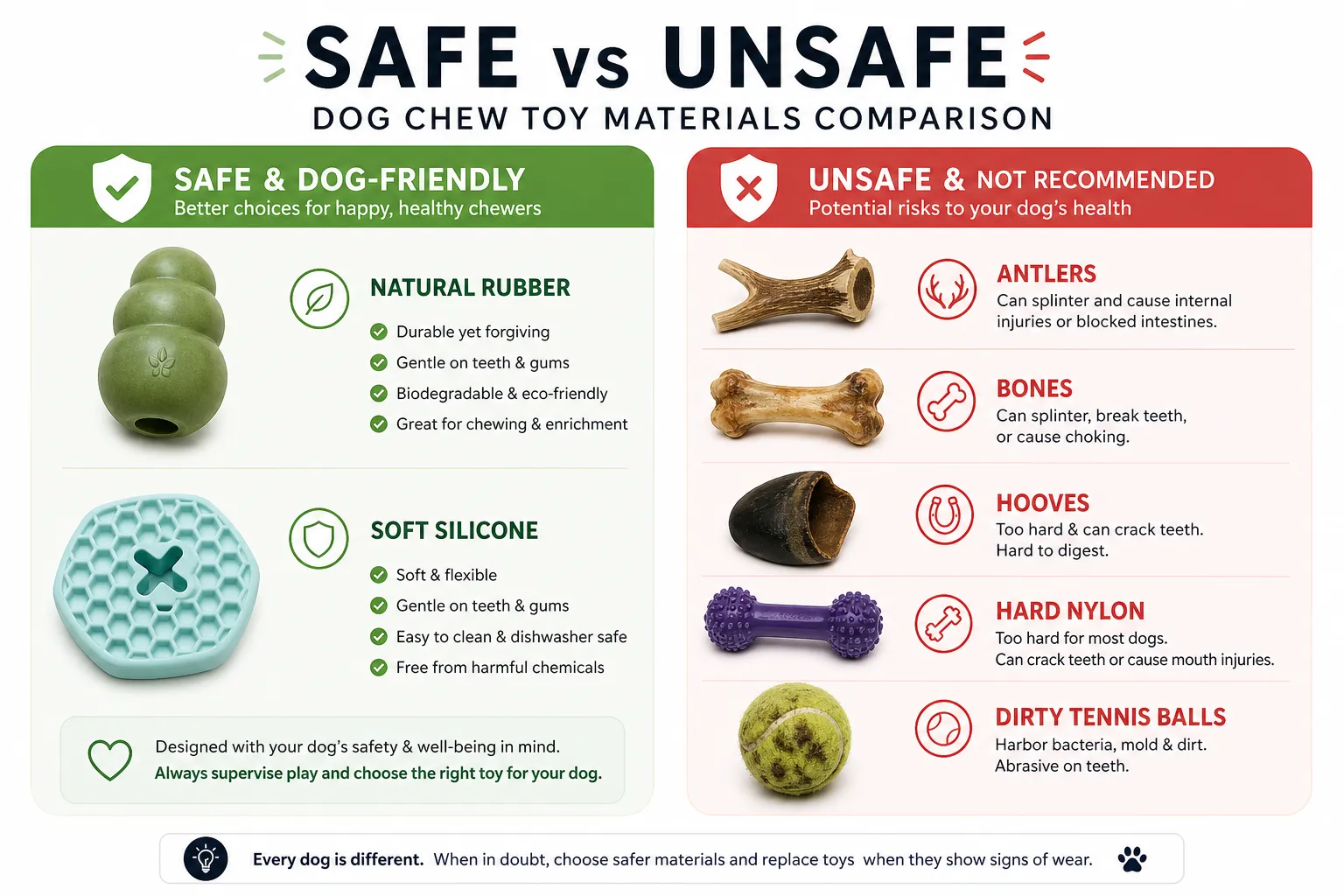
Material Comparison Table
Material | Usually a Good Choice? | Why It Can Work | Main Caution |
|---|---|---|---|
Natural rubber | Yes | Durable, flexible, common in safer chew designs | Replace if cracked or chunked |
Pet-safe silicone | Often | Softer feel, useful for lighter chewers and some puppy toys | May not hold up for heavy chewers |
Thick rope | Sometimes | Good for tug and supervised chewing | Can fray and be swallowed |
Plush fabric | Rarely for chewing | Fine for comfort or gentle play | Not suitable for dedicated chewers |
Hard nylon | Use caution | Long-lasting for some dogs | Can be too hard on teeth |
Antlers | No for most dogs | Long-lasting | High risk of tooth fractures |
Natural bones | No for most dogs | Strong chewing appeal | Can crack teeth or splinter |
Hooves | No for most dogs | Very hard | Dental injury risk |
Ice cubes for chewing | No | Easy access | Can damage teeth in strong chewers |
Tennis balls | Limited use | Fine for fetch in moderation | Fuzzy coating can wear teeth down |
Best Overall Material Direction
For many dogs, safe chew toys for dogs are most often found in the flexible-rubber category. These toys are usually easier on teeth than very hard chews, come in different sizes, and often support enrichment through stuffing or treat play.
If your dog loves problem-solving more than brute-force chewing, enrichment toys can also be a smart option. A structured feeder or puzzle-style toy may reduce repetitive hard chewing while still keeping your dog engaged. Pawzis carries practical enrichment options like this interactive dog puzzle feeder treat dispenser for pet parents who want mental stimulation built into daily routines.
Why Size Matters More Than Many Owners Realize
A toy can be made from a decent material and still be unsafe if it is the wrong size.
Too Small Is the Biggest Problem
If a toy can slip fully behind the canine teeth or be swallowed whole, it is too small. This risk increases with:
Powerful chewers
Dogs who grab and gulp
Multi-dog homes where one dog steals another’s toy
Puppies exploring everything orally
Too Large Can Also Be a Poor Fit
Oversized toys can cause awkward jaw positioning, make play less rewarding, and discourage use. The goal is a toy your dog can grip comfortably without being able to swallow.
A Practical Size Rule
When in doubt, choose a toy with a diameter wider than your dog’s lower jaw can comfortably compress around in one bite. Brand charts help, but your dog’s real mouth shape matters more than generic weight ranges.
Match the Toy to the Chewer, Not the Label
A package that says “power chewer” does not guarantee a good match. You need to identify how your dog chews.
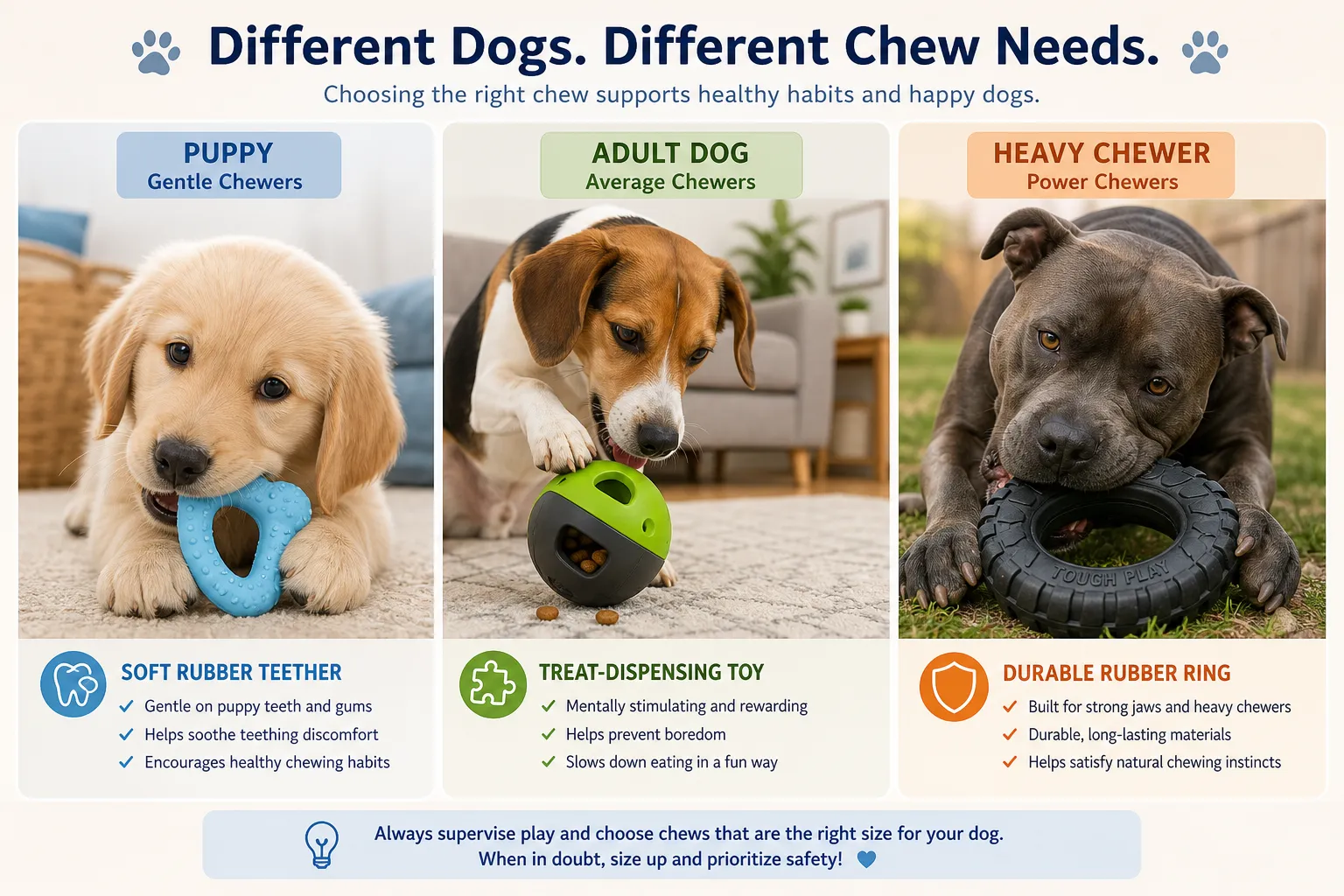
Puppies
Puppies chew because of teething, curiosity, boredom, and self-soothing.
Look for:
Softer rubber
Puppy-specific sizing
Lightweight designs
Easy-to-clean surfaces
Avoid:
Very hard chews
Adult-size heavy-duty toys
Toys with loose seams or tiny parts
Puppies also benefit from variety. Rotating textures and toy types can help redirect chewing away from shoes, table legs, and hands.
Average Chewers
These dogs enjoy chewing but do not usually destroy everything quickly.
Look for:
Medium-density rubber toys
Stuffable toys
Balls without fuzzy abrasive surfaces
Rope toys for supervised play
Avoid:
Toys that shred quickly
Brittle plastics
Overly hard “indestructible” items
Average chewers often do best with a small rotation of chewing, fetch, and enrichment toys rather than one all-purpose toy.
Heavy Chewers
Heavy chewers clamp hard, work persistently, and often try to tear chunks off.
Look for:
Thick, flexible rubber
One-piece construction
Larger diameter toys
Minimal seams, ridges, or attachments
Avoid:
Plush toys marketed as “tough”
brittle hard chews
real bones and antlers
worn toys with bite grooves deep enough to catch teeth
If your dog regularly destroys toys, buying safer structure matters more than buying more toys. A carefully selected durable option is usually a better investment than cycling through cheap chewy toys that fail fast.
If you want a deeper look at durability and toy style differences, Pawzis also has a guide to the best chew toy for aggressive chewers.
The Dental Safety Issue Many Buyers Overlook
A lot of chew-toy shopping focuses on “Will my dog swallow this?” That is important – but it is not the whole story.
Dental injuries are common with excessively hard chews. A toy may be too durable for your dog if it risks damaging teeth during normal use.
“A good general rule of thumb is that a teeth-safe chew toy can be bent or twisted with your hands or indented with a thumb nail.” – Apex Veterinary Specialists
That simple rule is more useful than many marketing labels. “Strong,” “extreme,” and “tough” are not safety standards. Your dog’s teeth do not care what the package says.
Tennis balls also deserve a special note. While many dogs love them, the fuzzy outer surface can act like an abrasive, especially when dirt and grit get ground into the fabric. For dedicated chewers, that makes tennis balls a poor everyday chew choice.
Signs a Toy Is No Longer Safe
Even the best chew toys for dogs eventually wear out. Retire a toy right away if you notice any of the following.
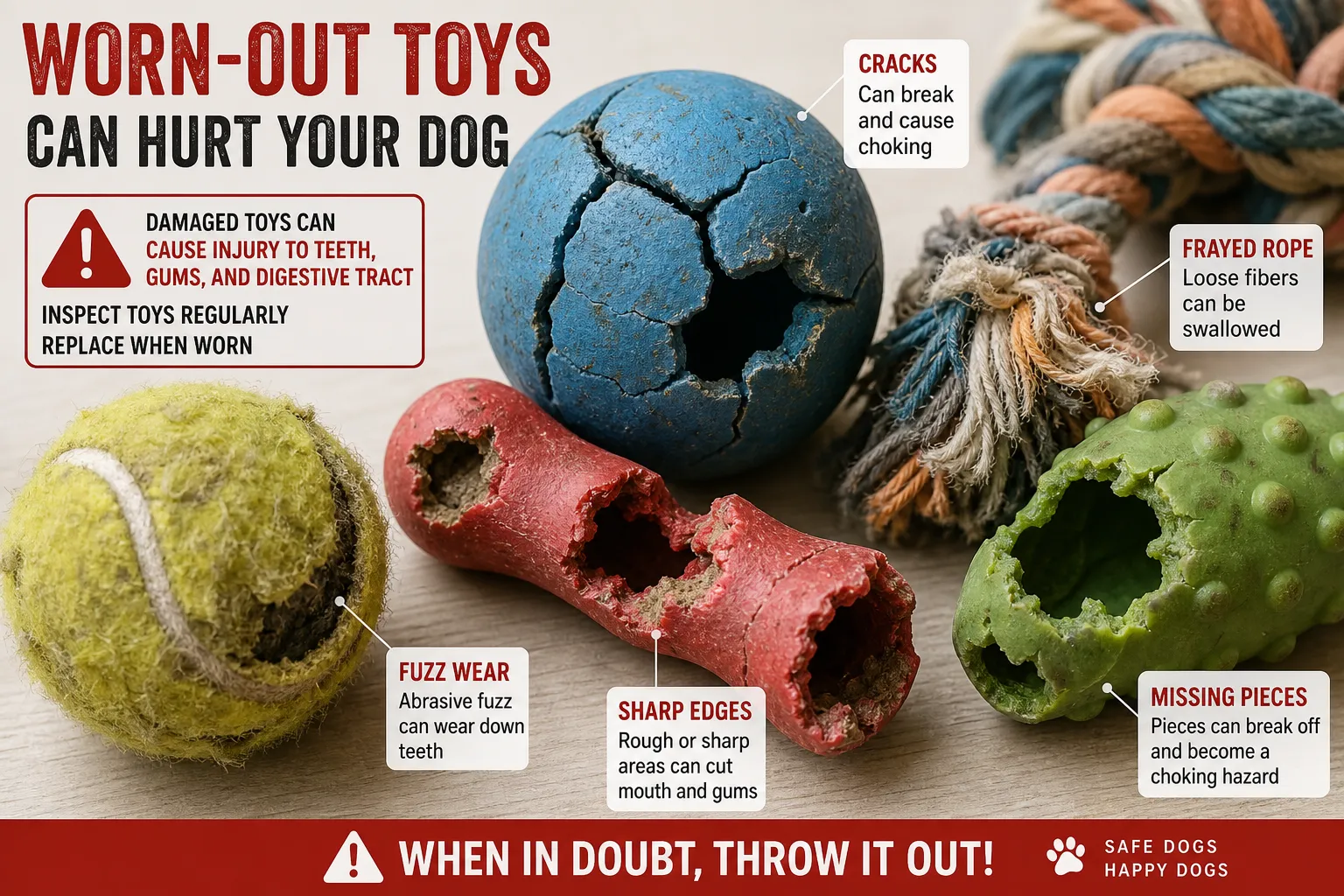
Replace It If You See:
Cracks
Sharp edges
Pieces missing
Deep punctures
Frayed rope strands
Seams opening
Detached squeakers or fillers
Flattened areas that expose weak spots
Sticky, degraded, or brittle texture changes
Also Replace It If Your Dog Shows:
Bleeding gums
Sudden reluctance to chew
Chipping or visible tooth wear
Repeated gagging or trying to swallow pieces
Excessive fixation on tearing off fragments
One of the easiest routines is to inspect chew toys weekly during toy cleanup. A quick squeeze-and-look check catches most problems early.
How to Judge a Toy Before Buying It Online
Buying online is convenient, but you cannot always hold the toy in your hand first. Here is how to evaluate it anyway.
Read Beyond the Product Title
“Durable” and “aggressive chewer” are starting points, not proof. Look for specifics:
material type
dimensions
one-piece vs. multi-part construction
care instructions
age or weight guidance
Study the Photos Closely
Zoom in and check for:
thin sections
glued pieces
decorative elements
weak handles
exposed seams
very narrow ends on bone-shaped toys
Look for Real Use Clues
Helpful reviews often mention:
whether the toy softened or cracked
how long it lasted with a dog of similar size
whether pieces came off
whether it worked better for chewing or enrichment
Favor Curated Shopping Over Endless Guesswork
One advantage of shopping with a focused pet-care store is less noise. Pawzis is built around practical everyday products, not overwhelming catalogs, so pet parents can compare options more clearly and get support when they need it. That matters when you are trying to choose smarter, safer chew toys for dogs instead of scrolling through hundreds of similar listings.
Safe Toy Types by Use Case
Different toy formats suit different goals. Here is a quick way to think about them.
Goal | Better Toy Type | Why |
|---|---|---|
Teething relief | Soft puppy rubber toys | Gentler on developing teeth |
Boredom reduction | Stuffable or puzzle toys | Adds mental work to the activity |
Fetch | Smooth rubber balls | Lower abrasion than tennis balls |
Tug | Thick rope or flexible tug toy | Best under supervision |
Solo chew time | Durable flexible rubber | Good balance of resilience and give |
Stress relief | Lickable enrichment or stuffable toy | Encourages calmer engagement |
For dogs who get overstimulated by constant chewing, enrichment can be especially helpful. Products like an interactive lick mat for dogs and cats can turn snack time into a slower, calmer activity that complements chew time rather than replacing it.
Common Buying Mistakes to Avoid
Assuming “Indestructible” Means Safe
No dog toy is truly indestructible. Safety depends on how your dog uses it, not just what the label promises.
Choosing the Hardest Option Available
Many owners understandably think tougher equals better. In reality, the hardest toys can be among the riskiest for teeth.
Ignoring Your Dog’s Play Style
A fetch lover, comfort chewer, and shredder need different toy structures.
Keeping Worn Toys Too Long
Familiar favorites often stay in rotation well past their safe life.
Letting Dogs Share Mismatched Toy Sizes
A large dog may swallow a small dog’s toy far more easily than you expect.
A Smarter, Safety-First Buying Checklist
Before purchasing, ask these five questions:
Is it made from a dog-safe material with some flexibility?
Is it large enough for my dog’s mouth and chew strength?
Does it avoid loose parts, weak seams, and brittle edges?
Would I feel comfortable pressing a thumbnail into it?
Does it suit chewing, enrichment, fetch, or tug based on how my dog actually plays?
If the answer is no to even one of those, keep looking.
Final Verdict
The safest way to choose chew toys is not to chase hype or the toughest-looking product. It is to match safe chew toys for dogs to your dog’s size, chewing style, and life stage while avoiding overly hard materials and replacing toys at the first sign of breakdown.
That is the kind of practical, everyday pet care Pawzis is built for. We focus on useful essentials, simpler shopping, and educational guidance that helps U.S. pet parents buy with more confidence. If you want dog and cat supplies chosen around real routines – not a giant maze of generic listings – explore Pawzis for practical play, grooming, comfort, and feeding products backed by human customer support, free standard U.S. shipping, and 30-day returns.
FAQ
What do vets recommend for dog chew toys?
Vets commonly recommend appropriately sized, durable, flexible chew toys, especially rubber toys that have some give. They also advise matching the toy to your dog’s chewing style and avoiding items that are hard enough to crack teeth.
What is the safest dog chew toy?
The safest dog chew toy is usually a one-piece, flexible rubber toy sized correctly for your dog and free from loose parts. No toy is universally safest for every dog, so supervision and regular inspection still matter.
What is the safest material for dog chew toys?
Natural rubber is often one of the safest materials because it can be durable without being excessively hard. Some pet-safe silicone toys also work well for lighter chewers and puppies, depending on durability.
What is the healthiest thing for dogs to chew on?
The healthiest option is usually a safe, size-appropriate chew toy that supports chewing without damaging teeth or breaking into pieces. For many dogs, flexible rubber enrichment toys offer a good balance of mental stimulation and safer chewing.
What dog chews should I avoid?
You should generally avoid very hard chews such as antlers, hard bones, hooves, and other items that can fracture teeth. Also avoid toys that are too small, have loose parts, or are already cracked, frayed, or missing pieces.
Why don’t vets like bully sticks?
Some vets are cautious about bully sticks because they can pose calorie, bacteria, digestive, or swallowing concerns, especially if a dog gulps the end piece. They are not automatically unsafe, but they should be size-appropriate and closely supervised.